
+1 (248) 436-8160
Recent Posts
- » Popular Configuration: The Prizmatix STSI LED for PdCO Opsin
- » Popular Configurations: LEDs for Photoconversion of KikGR, Kaede, and More
- » Popular Configuration: Lumiworks LEDs for High-Speed Imaging in Laser Welding and Additive Manufacturing
- » Updated FAQ Page with New Customs and Tariffs Information
- » Easy Photochemistry Setup with Prizmatix Modular Mic-LEDs and the Cuvette Holder Optiblock
Popular Configuration: The Prizmatix STSI LED for PdCO Opsin
Posted by Nathaniel Sperka on 12th Nov 2026
Over the past year or so, we have been getting a lot of interest in our STSI for PdCO, an increasingly popular opsin.
PdCO is a bistable opsin that gives researchers long-lasting, reversible control without continuous illumination. A short pulse of violet switches it on, and a pulse of green switches it off. For this you need to deliver the two colors to the brain via fiberoptics. The Prizmatix STSI LED is built for this kind of work, and more neuroscience labs are using it every year.
Two colors, one fiber 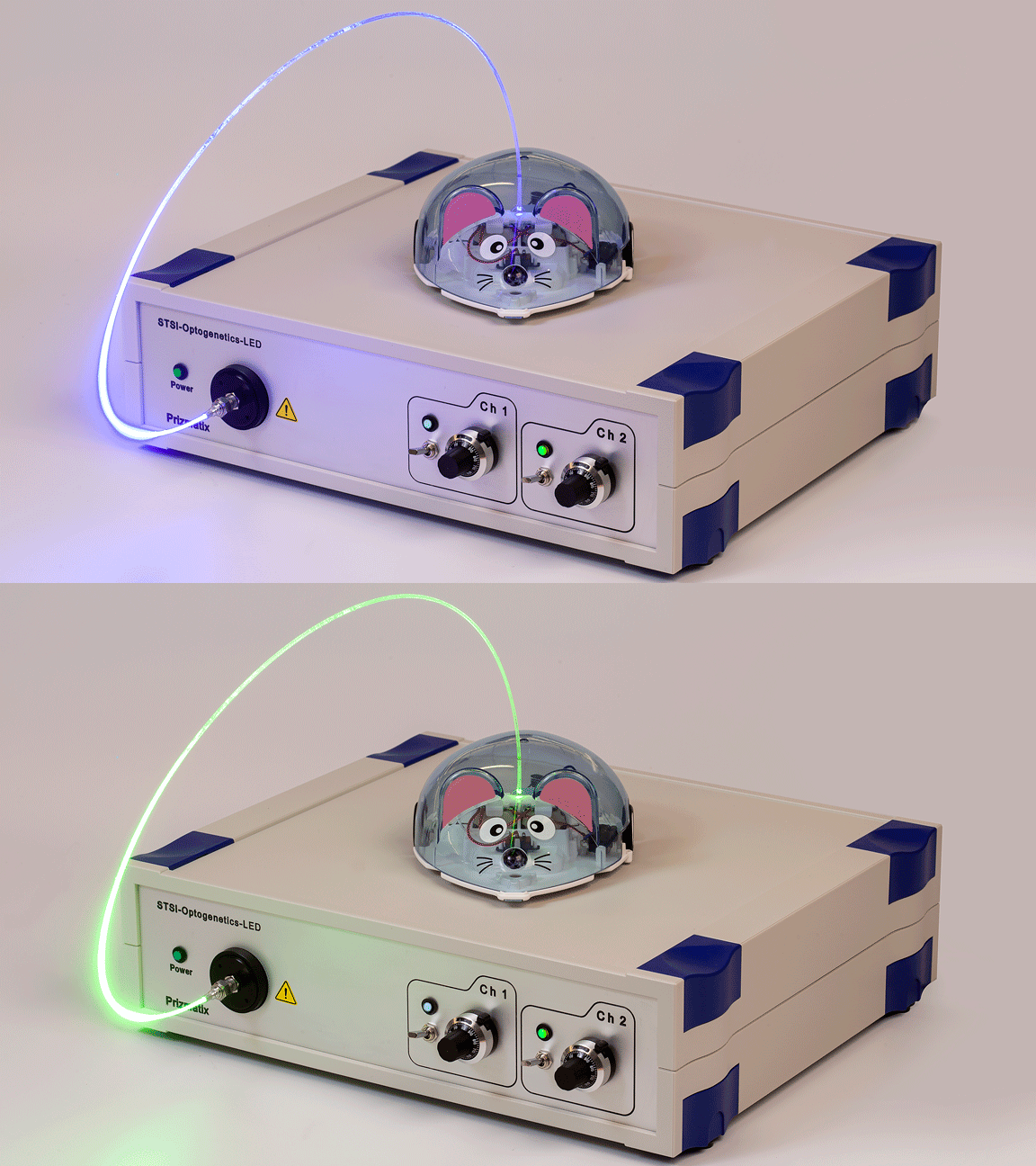
The STSI combines two independently controlled LEDs into a single output fiber, so both wavelengths reach the subject through the shared fiberoptics. For PdCO, violet plus green is the most common pairing. Typically researchers order violet (405 nm) and green (520 nm). Some researchers prefer lime-green, a broad-spectrum 545 nm LED, so they can also use the light source for other opsins such as ArchT and halorhodopsin .
Bilateral delivery from one light source
One STSI can deliver both colors to both hemispheres of a single freely moving animal. Light goes into a large-core fiber connected to the Prizmatix rotary joint, with a Y-shaped fiber on the spinning side. The light is split into two branches, each delivering nearly the same power as a single fiber. You get bilateral activation and silencing from a single light source and a simple rotary joint, with no need for a complicated rotary joint with two input and output fibers.
Built for in vivo optogenetics
- Dedicated TTL input for each color, with <10 µs rise and fall times
- Manual power control with 10-turn potentiometers, or 0-5 V analog control
- Opto-isolated inputs to protect electrophysiology recordings
- Ultra-low-torque rotary joint for unrestricted movement
View the LED, with power data and spectrum, on the Prizmatix STSI page.
Complete systems from Goldstone Scientific
We offer the Prizmatix STSI complete system, including the LED, rotary joint, and fibers, so you can order everything for your PdCO experiment in one place. Fiberoptic implants need to be ordered separately, or you can make your own high-NA cannula using raw materials available from our webstore.
Questions about wavelengths, fibers, or bilateral setups? Call 248-436-8085 or contact me via the website chat.