
Goldstone Scientific Blog
Popular Configuration: The Prizmatix STSI LED for PdCO Opsin
Posted by Nathaniel Sperka on 12th Nov 2026
Over the past year or so, we have been getting a lot of interest in our STSI for PdCO, an increasingly popular opsin.
PdCO is a bistable opsin that gives researchers long-lasting, reversible control without continuous illumination. A short pulse of violet switches it on, and a pulse of green switches it off. For this you need to deliver the two colors to the brain via fiberoptics. The Prizmatix STSI LED is built for this kind of work, and more neuroscience labs are using it every year.
Two colors, one fiber 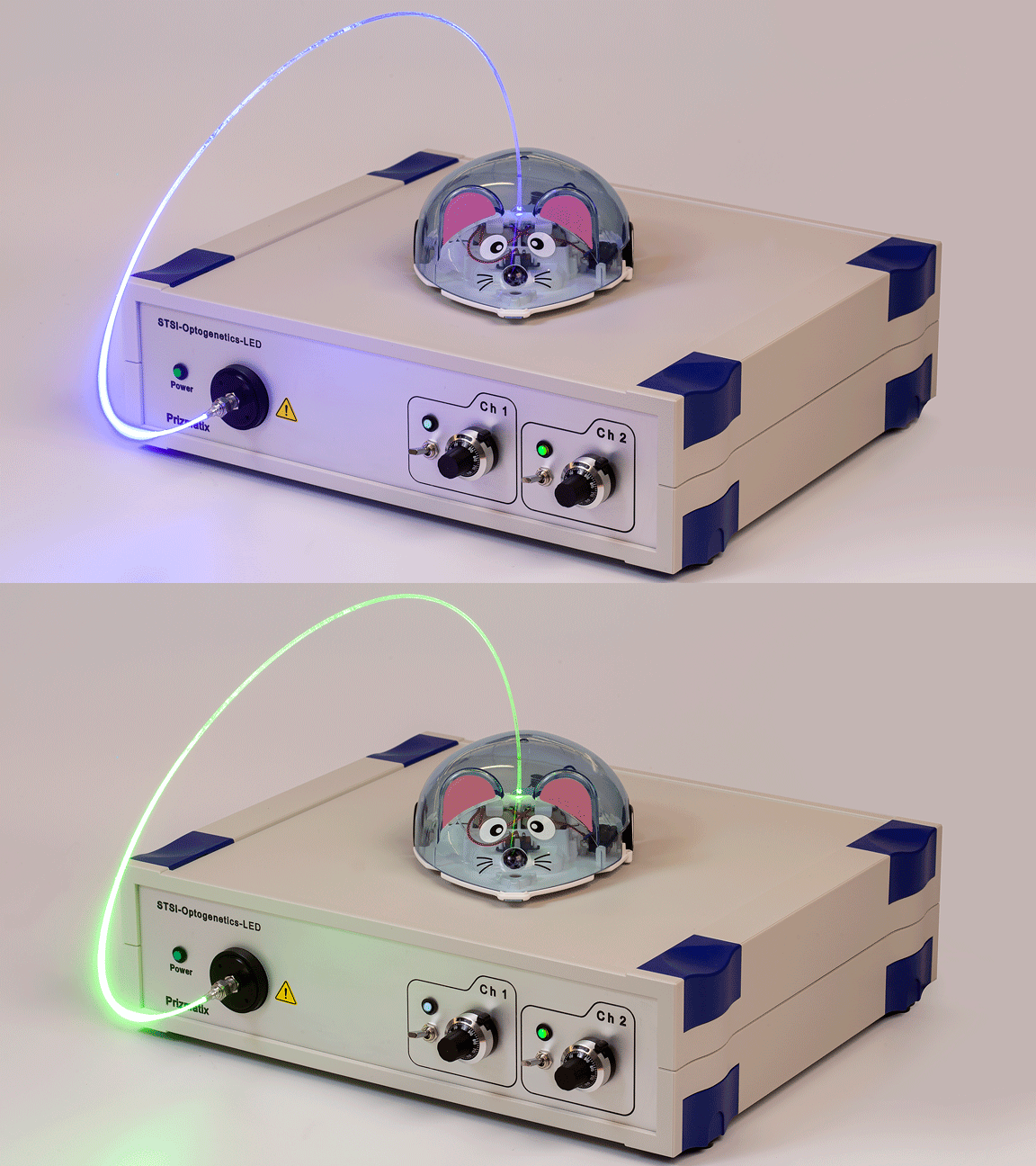
The STSI combines two independently controlled LEDs into a single output fiber, so both wavelengths reach the subject through the shared fiberoptics. For PdCO, violet plus green is the most common pairing. Typically researchers order violet (405 nm) and green (520 nm). Some researchers prefer lime-green, a broad-spectrum 545 nm LED, so they can also use the light source for other opsins such as ArchT and halorhodopsin .
Bilateral delivery from one light source
One STSI can deliver both colors to both hemispheres of a single freely moving animal. Light goes into a large-core fiber connected to the Prizmatix rotary joint, with a Y-shaped fiber on the spinning side. The light is split into two branches, each delivering nearly the same power as a single fiber. You get bilateral activation and silencing from a single light source and a simple rotary joint, with no need for a complicated rotary joint with two input and output fibers.
Built for in vivo optogenetics
- Dedicated TTL input for each color, with <10 µs rise and fall times
- Manual power control with 10-turn potentiometers, or 0-5 V analog control
- Opto-isolated inputs to protect electrophysiology recordings
- Ultra-low-torque rotary joint for unrestricted movement
View the LED, with power data and spectrum, on the Prizmatix STSI page.
Complete systems from Goldstone Scientific
We offer the Prizmatix STSI complete system, including the LED, rotary joint, and fibers, so you can order everything for your PdCO experiment in one place. Fiberoptic implants need to be ordered separately, or you can make your own high-NA cannula using raw materials available from our webstore.
Questions about wavelengths, fibers, or bilateral setups? Call 248-436-8085 or contact me via the website chat.
Bilateral and Unilateral Fiberoptics for Head-Fixed and Non-Moving Animals
The Prizmatix Optogenetics LED systems shown on our webstore are configured for moving animals. Many researchers use head-fixed, anesthetized, or other nonmoving animals and wonder what the set up should look like.How to configure Bilateral fiberoptics without a rotary jointMany customers want to deliver light bilaterally and wonder if they can connect the Y shaped fiber directly [...]
How to make your own fiberoptic implants for Optogenetics
Goldstone Scientific offers the supplies you need to prepare your own fiber optic implants (“cannulae”) for In-Vivo Optogenetic experiments. Prizmatix created this step-by-step video tutorial which shows you how to do it. Written Instructions can be seen at: https://www.prizmatix.com/pdf/optogenetics/DIY_Cannula_Instructions.pdf The products used in the video are: DIY Kits, includes almost everything to get started including epoxy. Does not [...]
Illumination Inside of an Incubators and CO2 Chambers – Part II
I wrote the first blog post on the topic on illumination inside of an incubator, in 2014. There have been major changes since then. The challenge has not changed; the solutions have. The challenge is to deliver intense light over a microwell plates or petri dishes inside of a chamber where the conditions could damage the LED, and [...]
Light Meters, Fiber Optics and Optogenetics – Part 5 Little Mistake, Big Problem
A customer was getting much lower power than expected from the fiber optics of his Prizmatix Optogenetics LED. His entire system including his power meter was shipped to our lab for debugging. Turns out the whole problem was the FC adapter on the detector of his power meter. The purpose of this FC fiberoptic connector/adapter is to [...]
Light Meters, Fiber Optics and Optogenetics – Part 4 –Using Integrating Sphere Correctly
In my previous blog post about Light Meters I explained why the ideal detector for measuring light from a LED compatible high NA fiber optic is a detector built into an integrating sphere. This post describes the best method for taking the measurements from Prizmatix fiber optic experts. Here is their advice: The correct way of measuring Power for [...]
Light Meters, Fiber Optics and Optogenetics – Part 3 – Prizmatix’s Advice on Light Meters for Optogenetics
I am often asked to recommend light meters to use for testing the fiber optic implants that will be used in Optogenetic experiments. This is important in order to test the quality of each implant and make sure everything is working correctly. Measuring the light correctly is not a trivial matter. The meter setting, the detector and [...]
High NA Fiber Optics for In-Vivo Optogenetics – The Options on Goldstone Scientific
Quality fiber optic implants are crucial for successful in-vivo Optogenetics. Scientists will need to spend time or money (or both) to ensure quality results. Prizmatix offers a range of options and Goldstone Scientific makes it easy to order and offers competitive prices with bulk discounts and fast shipping to save you both. Many items are [...]
Light Meters, Fiber Optics and Optogenetics – Part 1 – Light Meter Blues
Prizmatix LEDs are extremely powerful and our customers are generally very satisfied with their performance. Sometime, however, I get complaints about the power output being lower than expected as per the published specification. Very frequently it turns out that the light source is fine, and the problem lies within the tools and methods used to measure the power. In [...]

Prizmatix Fiber Optic Rotary Joint; Compatibility of with Lasers or other light sources
The Prizmatix Fiber Optic Rotary Joint is an important part of the Prizmatix In-Vivo Optognetics Toolbox. It’s extremely low torque (<10μNm) allows even the smallest animals to move freely and its high transmission is helpful in getting as much power as possible to the target. One really nice feature of the Prizmatix fiber optic rotary joint is that it can be used [...]